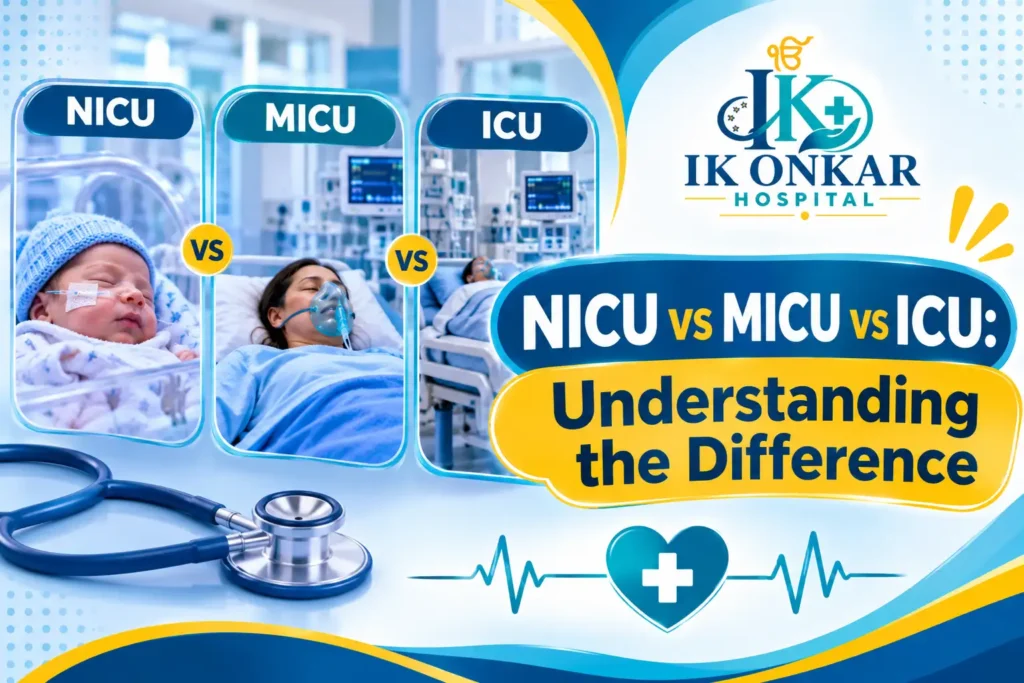
Doctor kabhi NICU, MICU ya ICU bolte hain. Then families confuse ho jaati hain. They wonder what each word means. In simple words, the difference between NICU and MICU depends on the patient’s age and need.
NICU is for newborn babies. MICU is for adults with serious illness. Meanwhile, ICU is the general term for critical care.
In this guide, we explain the difference between NICU and MICU step by step. We also cover NICU meaning, MICU meaning, and ICU meaning. As a result, you can understand the doctor’s advice better.
What Do NICU, MICU, and ICU Mean?
Each term points to a different type of care. Let us look at them one by one.
NICU Meaning
NICU means Neonatal Intensive Care Unit. It cares for sick or weak newborn babies. Many of them are born early.
MICU Meaning
MICU means Medical Intensive Care Unit. It cares for adults with serious illness. These patients need close watching.
ICU Meaning
ICU means Intensive Care Unit. It treats critically ill patients day and night. It is a broad term.
However, hospital names can differ. For example, some hospitals have a surgical or cardiac ICU. Therefore, the doctor picks the unit that suits the patient.
NICU Meaning in Detail: What Is a NICU?
A NICU is a special unit for newborn babies. These babies need extra care. Some also need help with breathing or feeding.
Which Babies May Need NICU Care?
A baby may need a NICU for several reasons. First, a premature birth is common. Babies born before 37 weeks may have weak lungs.
Second, low birth weight can cause problems. Small babies need help with warmth and feeding. Third, some babies have breathing trouble. They may need oxygen.
Similarly, some infections need close watching. In addition, serious jaundice needs treatment. Finally, seizures or birth defects may also need special care.
Still, not every small baby needs a NICU. Doctors check each baby first.
What Care Does a NICU Provide?
The care depends on the baby. For example, the team checks heart rate, breathing, and temperature. Moreover, they keep the baby warm in an incubator.
If needed, they give breathing support. Likewise, they help with feeding. They also give fluids and medicines. In addition, they do tests when the doctor advises.
A NICU team has neonatologists, paediatricians, and nurses. However, the team may differ by hospital.
MICU Meaning in Detail: What Is a MICU?
A MICU is for adults with serious medical illness. These patients need close care. Besides, some need support for vital organs.
A NICU treats newborns. A MICU, on the other hand, treats adults. Still, age rules may differ between hospitals.
Which Patients May Need MICU Care?
A doctor may suggest a MICU in many cases. For instance, severe lung illness can lower oxygen. Similarly, sepsis needs close care. Kidney failure may also need it.
In addition, serious diabetes problems can need a MICU. Moreover, some brain emergencies need it too.
Please note that a diagnosis alone is not enough. Instead, the doctor checks how severe the illness is. They also see how the patient responds to treatment.
What Care Does a MICU Provide?
First, the team checks vital signs all the time. Next, they give oxygen or breathing support. They also give medicines and fluids through a vein.
Besides, they do blood tests. They check kidney function and blood pressure often. Overall, the goal is simple. The team gives the support the patient needs.
ICU Meaning in Detail: What Is an ICU?
An ICU is for critically ill patients. These patients need constant monitoring. They also need special treatment.
For example, a hospital may have a general ICU. In addition, it may have a MICU or cardiac ICU.
Which Patients May Need ICU Care?
A patient needs an ICU when a normal ward is not enough. For example, severe breathing problems may need it. Likewise, sepsis may need it.
Moreover, major problems after surgery can lead to an ICU. Severe injury may also need it. Finally, serious heart or kidney problems may need it too.
What Happens in an ICU?
First, the team watches heart rate, blood pressure, and oxygen. Next, they give oxygen or breathing support if needed. They also give medicines through a vein.
In addition, they do lab tests and scans. Meanwhile, the care team reviews the patient again and again. However, not every ICU patient needs a ventilator.
Difference Between NICU and MICU: Main Points
The difference between NICU and MICU is the type of patient. A NICU treats newborn babies. A MICU treats adults with serious illness. Both use close monitoring. However, their teams and equipment are different.
Remember one more point. NICU and MICU are not levels of seriousness. Instead, they serve different patients. Therefore, knowing the difference between NICU and MICU helps you understand why a patient moves to one unit.
NICU vs MICU vs ICU: Quick Comparison
NICU: Neonatal Intensive Care Unit. It treats newborn babies. Common reasons are premature birth, low birth weight, and breathing problems.
MICU: Medical Intensive Care Unit. It mostly treats adults. Common reasons are serious infection, lung illness, and organ problems.
ICU: Intensive Care Unit. It treats critically ill patients. Common reasons are severe illness, injury, and surgery problems.
Some hospitals arrange their units differently. However, this is the common pattern.
How Do Doctors Choose the Right Unit?
Doctors look at age, illness, and symptoms. Moreover, they check how much support the patient needs.
First, age matters. A newborn may need a NICU. An adult may need a MICU or ICU. Second, the team finds the illness. Third, they check breathing, alertness, and lab results.
Finally, the hospital checks its staff and equipment. If something is missing, it may transfer the patient. Therefore, families can ask why a unit was chosen.
Is NICU or MICU More Serious?
Neither unit is always more serious. They care for different patients. As a result, seriousness depends on the patient.
For example, a newborn in a NICU may need strong breathing support. Similarly, an adult in a MICU may need sepsis treatment. Both can be serious. Therefore, ask the doctor to explain the condition.
When Should You Seek Emergency Help?
Do not wait if symptoms get worse fast. Instead, get urgent help at once. Warning signs include severe trouble breathing, loss of consciousness, and seizures.
Besides these, severe chest pain needs urgent care. Sudden weakness or trouble speaking also needs it. Likewise, heavy bleeding or collapse needs help now.
For newborns, danger signs include hard breathing, blue or grey skin, and seizures.
In India, 112 is the national emergency number. Call for help first. Do not delay care to choose a department.
Choosing a NICU Hospital Faridkot, MICU Hospital Faridkot, or Critical Care Hospital
Many families search for a NICU hospital Faridkot or a MICU hospital Faridkot. Others look for a critical care hospital. However, first understand the patient’s exact need.
A good critical care hospital needs the right doctors and equipment. Still, the word ICU alone does not prove it can treat every condition. Therefore, always ask about the service you need.
Ik Onkar Hospital is at Former Dashmesh Hospital Building, Talwandi Road, Faridkot, Punjab. Families should contact the hospital directly. In this way, they can confirm current NICU, MICU, and critical care services.
Useful Questions to Ask
First, ask if the needed service is available now. Next, ask which conditions the unit can manage. Then, ask what monitoring and breathing support exists.
Also, ask which doctors take part in care. Moreover, ask about visiting rules. Finally, ask how transfer is arranged if a service is missing.
However, in an emergency, get help at once. Do not wait to compare hospitals.
Conclusion
The difference between NICU and MICU helps families understand intensive care. NICU meaning is newborn intensive care. MICU meaning is intensive medical care for adults. Finally, ICU meaning is the broad term for critical care.
The right unit depends on age, illness, and support needed. Therefore, families should confirm the services of any NICU hospital Faridkot, MICU hospital Faridkot, or critical care hospital before choosing.
This article is for general education. It does not replace advice from a qualified doctor.
Stay Connected with Ikonkar Hospital
Stay connected with Ikonkar Hospital for healthcare updates, health awareness information, patient care guidance, and useful wellness tips. Visit our website to learn more about our hospital and services. Follow Ikonkar Hospital on Facebook and Instagram for the latest health updates, hospital news, and informative healthcare content.