A baby’s birth weight gives useful information about health. However, it does not tell the whole story. For example, some babies are born small and need extra help with feeding, warmth, or breathing. Meanwhile, others are healthy but need close watching in the first few days.
Low Birth Weight Baby Care means checking the baby closely and giving the right support. In addition, it covers feeding, body warmth, breathing, and weight gain. The type of care depends on the baby’s weight, age, and health. Therefore, knowing how Low Birth Weight Baby Care works helps parents ask the right questions.
What Is a Low Birth Weight Newborn?
A low birth weight newborn weighs less than 2,500 grams (2.5 kg) at birth. This is true no matter how long the pregnancy lasted.
Low birth weight is a measurement, not a disease. Thus, it does not always mean the baby is seriously ill. In fact, many small babies stay with their mothers and do well with simple support.
Doctors usually look at two situations:
- Premature birth: The baby is born before 37 weeks of pregnancy. Because of this, the baby often weighs less.
- Small for gestational age: The baby is smaller than expected for the weeks of pregnancy. Moreover, this can happen even after 37 weeks.
Sometimes a baby is both premature and small. As a result, the Premature Baby Care needs may differ from those of a baby who is only small.
Why Are Some Babies Born With Low Birth Weight?
There can be many reasons. Sometimes one cause is clear. In other cases, several factors play a part.
Premature Birth
A baby born early has less time to grow inside the womb. Consequently, the weight is often lower. Such babies may also need extra help with breathing, feeding, and warmth. For this reason, good Premature Baby Care is very important.
Slow Growth in the Womb
Some babies do not grow as expected during pregnancy. For instance, placenta problems can be one cause. Likewise, certain health conditions in the mother can play a role. After that, the obstetric team checks the cause and plans follow-up.
Mother and Pregnancy Factors
Several factors can raise the chance of a low birth weight newborn:
- Certain health conditions in the mother
- Poor nutrition during pregnancy
- Smoking or tobacco exposure
- Twins or triplets
- Placenta problems
- Late or missed antenatal check-ups
Of course, these factors do not mean every pregnancy will have this result. Still, regular antenatal visits help doctors find problems early.
Why Do Small Babies Need Hospital Monitoring?
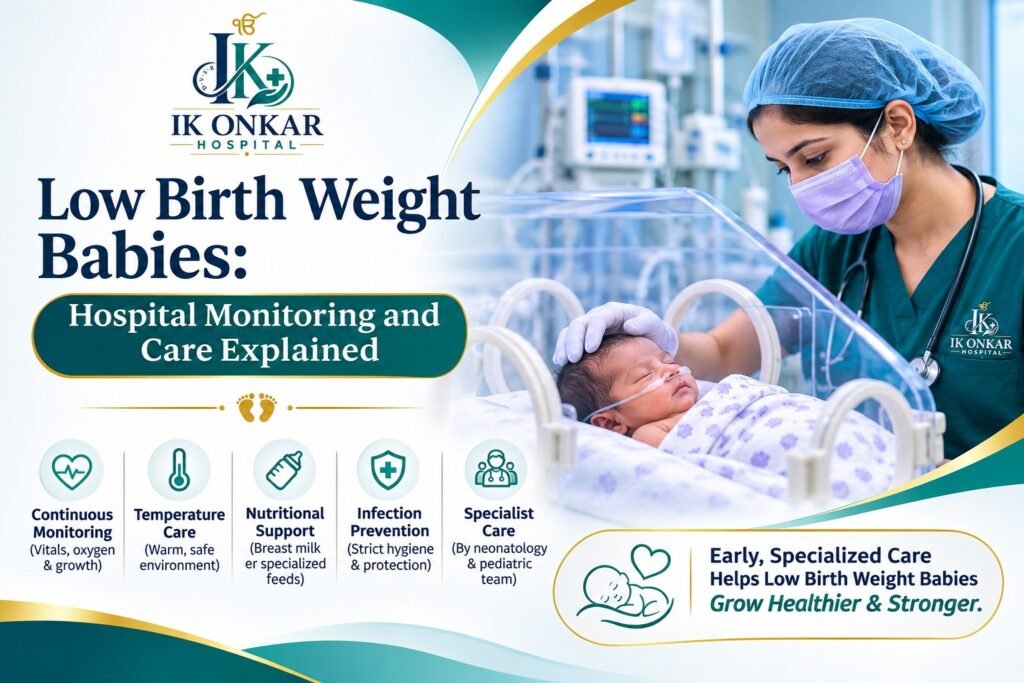
Small babies lose body heat quickly. In addition, they may tire during feeding. Their blood sugar can also drop too low. Furthermore, some may have breathing trouble, jaundice, or infection.
Newborn Monitoring helps the team spot these problems early. Then they can decide what support the baby needs.
However, not every small baby needs intensive care. For example, a stable baby may need only routine checks and feeding help. In contrast, a baby with serious problems may need Neonatal Care in a NICU. Ultimately, the decision depends on the baby’s overall condition, not on weight alone.
What Do Doctors Check During Newborn Monitoring?
Every baby gets a plan that suits their needs. Besides that, doctors and nurses repeat the checks as needed.
Body Temperature
Small babies cool down faster than full-term babies. Therefore, the team checks if the baby can stay warm. Depending on need, they may use an incubator, a warmer, or skin-to-skin contact.
Breathing and Oxygen
First, the team watches the breathing pattern and chest movement. They also check oxygen levels when needed. However, fast breathing, grunting, or pauses in breathing need quick medical care. In some cases, babies need extra breathing support.
Feeding and Blood Sugar
Small babies may tire quickly while feeding. In fact, some cannot suck, swallow, and breathe together yet. For this reason, doctors check how well the baby feeds. They also test blood sugar when there is a risk or a symptom. Above all, poor feeding or unusual sleepiness should be reported at once.
Weight Gain and Growth
Regular weight checks show if the baby is getting enough milk. In addition, doctors may measure length and head size. However, one weight reading is not enough. Instead, the team looks at the full picture before judging growth.
Jaundice and Infection
Jaundice makes the skin and eyes look yellow. Although it is common in newborns, some babies need treatment. Similarly, the team watches for infection. For example, poor feeding, odd sleepiness, and changes in temperature or breathing can be warning signs.
What Care Does a Low Birth Weight Baby Need?
Care depends on the problems found during checks. For example, one baby may need only feeding help. On the other hand, another baby may need special treatment. Overall, good Low Birth Weight Baby Care is always planned for the individual baby.
Care may include:
- Warmth support: An incubator or warmer helps the baby stay warm.
- Feeding support: The baby may get breastfeeding help, expressed milk, or tube feeding.
- Blood sugar checks: Tests are done when the baby is at risk.
- Breathing support: Oxygen, CPAP, or a ventilator may be needed.
- Jaundice care: Phototherapy may be used when needed.
- Infection treatment: Tests and medicines are given if infection is suspected.
However, not every baby needs all of these. Instead, the medical team decides what is right.
Feeding Tips for Low Birth Weight Babies
Babies need energy and nutrients to grow. Therefore, feeding is a key part of Neonatal Care.
Breast milk is usually the best choice, even for small and premature babies. Besides giving nutrition, it also helps protect against illness. For this reason, doctors support breast milk whenever it is safe.
Depending on the baby’s health, feeding may include:
- Direct breastfeeding, when the baby can latch well
- Expressed breast milk, when direct feeding is not yet possible
- Tube feeding, when the baby cannot take enough by mouth
- Special nutrition, when the doctor advises it
Please follow the feeding plan from the baby’s doctors. Also, do not give water, honey, animal milk, or supplements without medical advice. Finally, call the team if the baby feeds poorly, vomits often, or has fewer wet nappies.
What Is Kangaroo Mother Care?
Kangaroo mother care (KMC) means long skin-to-skin contact between baby and parent. In addition, it includes breast milk feeding and regular follow-up.
KMC helps keep the baby warm. Moreover, it supports breastfeeding and bonding. For this reason, it is an important part of Premature Baby Care.
Parents should ask the team how to practise KMC safely. After all, some babies need extra care and supervision first. Also, never remove monitoring wires or change the baby’s position without staff guidance.
When Does a Small Baby Need NICU Care?
A baby may need the NICU when routine newborn care is not enough. For example, the baby may need constant monitoring or special treatment.
Common reasons include:
- Serious breathing difficulty
- Trouble staying warm
- Repeated low blood sugar
- Poor feeding that needs special support
- Serious infection or suspected sepsis
- Other problems that need close watching
However, low weight alone does not always mean NICU admission. First, doctors check the baby’s age, vital signs, feeding, and general health. Then they choose the right level of care.
Meanwhile, NICU services differ from one hospital to another. So parents should ask what the unit can manage. In addition, they should ask if a transfer might be needed.
Warning Signs Parents Should Not Ignore
A newborn can become unwell very quickly. Therefore, call a doctor right away if feeding, breathing, or behaviour changes.
Seek urgent help if the baby has:
- Fast, hard, or noisy breathing
- Blue or grey lips or skin
- Pauses in breathing
- Seizures or odd movements
- Extreme sleepiness or trouble waking
- Poor feeding or repeated vomiting
- Fever or a very low body temperature
- Much less urine than usual
- Yellowing that gets worse
In particular, severe breathing trouble, blue skin, seizures, or no response are emergencies. So do not waste time on home remedies.
Care After Going Home
Going home does not end the need for follow-up. In fact, small babies often need regular visits. These visits check feeding, growth, and development.
Parents can help by:
- Following the feeding plan
- Attending all weight and growth checks
- Keeping the baby warm without overheating
- Practising KMC when advised
- Placing the baby on their back to sleep, on a firm, flat surface with no loose bedding
- Keeping the home smoke-free
- Following the vaccination schedule
- Calling the doctor if feeding, breathing, or behaviour changes
Before leaving, ask when the next visit is due. Also, ask which signs mean an earlier visit.
Low Birth Weight Baby Care in Faridkot
Families looking for Low Birth Weight Baby Care in Faridkot should think about the baby’s own needs. After all, birth weight alone is not enough to decide.
A good hospital should check the baby’s breathing, warmth, feeding, blood sugar, jaundice, and growth. Moreover, if intensive care is needed, parents should confirm that the NICU Hospital Faridkot has the right services and equipment.
Ik Onkar Hospital is located at Former Dashmesh Hospital Building, Talwandi Road, Faridkot, Punjab.
Therefore, parents considering Ik Onkar Hospital should call the hospital first. By doing so, they can confirm current NICU services, staff availability, and whether the baby’s condition can be managed there.
Useful questions to ask:
- Is Newborn Monitoring available for a low birth weight newborn?
- What level of Neonatal Care does the hospital offer?
- Is feeding support available for babies who cannot feed well?
- Which breathing support options are available?
- What happens if the baby needs care beyond the hospital’s services?
- What follow-up visits are advised after discharge?
In short, these answers help families make safe and informed choices with their doctor.
Conclusion
Low Birth Weight Baby Care is about more than weight. Instead, it includes checking breathing, warmth, feeding, blood sugar, jaundice, and growth.
For example, some babies need only observation and feeding help. On the other hand, others need NICU care. Either way, the right plan depends on the baby’s health and should come from qualified doctors.
For families in Faridkot, it helps to confirm NICU services early. Likewise, timely follow-up after discharge supports the baby’s growth and health.
This article is for general education only. It does not replace a medical check-up or advice from a qualified doctor.