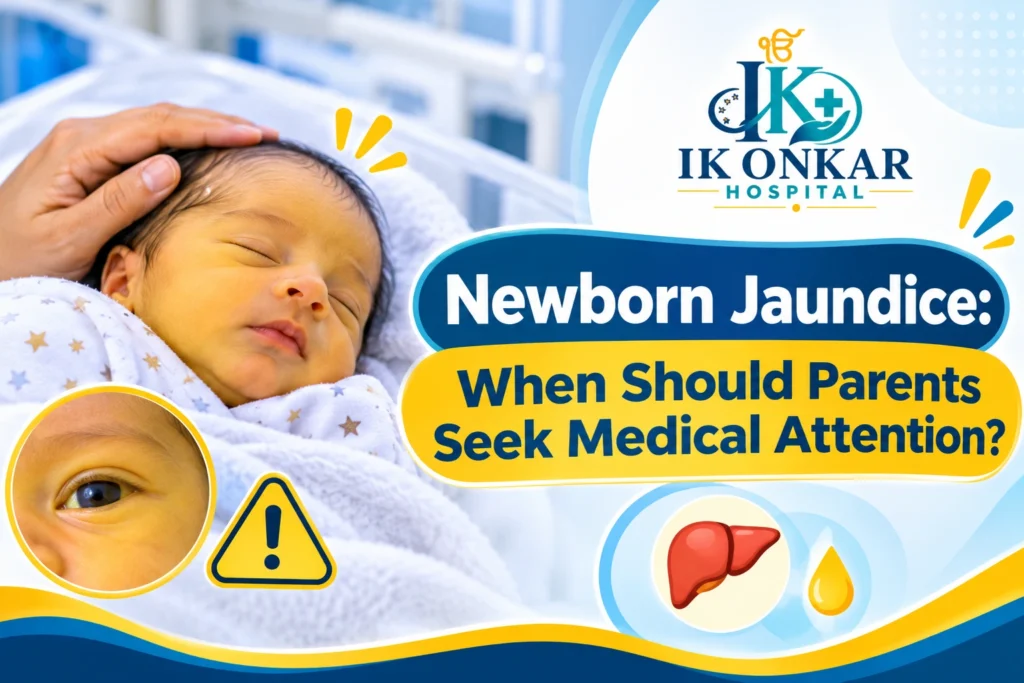
A newborn’s skin or eyes may look yellow in the first few days after birth. This is called newborn jaundice. It happens when bilirubin builds up in the baby’s blood.
Newborn jaundice is common, and many babies get better without strong treatment. However, some babies need quick medical checks, bilirubin monitoring, or phototherapy. In fact, very high bilirubin can cause serious problems if nobody treats it.
Good newborn jaundice care starts with knowing the warning signs. Therefore, this guide explains the causes, symptoms, tests, and newborn jaundice treatment. As a result, you will know when to act.
What Is Newborn Jaundice?
Newborn jaundice makes a baby’s skin and the whites of the eyes look yellow. Bilirubin causes this colour. The body makes it when old red blood cells break down.
Normally, the liver clears bilirubin from the body. In the first days of life, however, a baby’s liver is still maturing. So bilirubin can rise for a short time.
Doctors also use the term neonatal jaundice for this condition. Most babies show it in the first week. Usually, it improves as feeding settles and the liver grows stronger.
Skin colour alone cannot show how high the bilirubin is. For this reason, a doctor should examine the baby. Besides that, the doctor should order a bilirubin test when jaundice appears.
Why Do Newborns Develop Jaundice?
Some causes are part of normal life after birth. On the other hand, others need a closer look from a doctor.
Physiological Jaundice
Newborns break down many red blood cells, and their livers are still learning to keep up. As a result, bilirubin rises in the first few days. After that, it falls slowly as the liver matures.
Even mild neonatal jaundice needs a check. For that reason, parents should follow the advised newborn tests.
Breastfeeding-Related Jaundice
Some breastfed babies get too little milk in the early days. For example, a poor latch or infrequent feeds can cause this. Because less milk means fewer stools, the body removes less bilirubin.
Do not stop breastfeeding on your own. Instead, ask for feeding support and follow your doctor’s advice.
Blood Group Mismatch and Other Causes
Some conditions push bilirubin up faster or keep it high for longer. For instance:
- Blood group mismatch: when the mother’s and baby’s blood groups differ, the baby’s red cells break down faster.
- G6PD deficiency: this inherited condition raises the risk of red cell breakdown.
- Birth bruising: bruises or a blood collection under the scalp add bilirubin as the blood breaks down.
- Premature birth: a premature baby’s liver is less mature.
- Infection: some infections can cause jaundice.
- Liver or bile problems: these rarer conditions block normal bilirubin removal.
Overall, the cause matters because it guides treatment and follow-up.
Signs and Symptoms of Neonatal Jaundice
Yellow skin or yellow eyes are the main signs of neonatal jaundice. First, parents may notice:
- A yellow colour on the face or forehead
- Eyes with yellow whites
- Yellowing that spreads to the chest, belly, arms, or legs
- A yellow tint inside the mouth
- Poor feeding or unusual sleepiness
On darker skin, yellowing is harder to see. In that case, check the whites of the eyes and the inside of the mouth.
Importantly, never guess the bilirubin level by looking at the skin. Even mild yellowing may need a test.
When Should Parents Seek Medical Help?
Call a doctor as soon as you suspect jaundice. After all, the baby’s age, feeding, behaviour, and bilirubin level all matter.
Yellowing in the First 24 Hours
Yellowing in the first 24 hours needs urgent care. Moreover, it may point to fast red cell breakdown. Please do not wait for it to fade by itself.
Worsening Yellowing or Feeding Problems
See a doctor soon if you notice any of these signs:
- The yellow colour deepens or spreads
- Eyes look more yellow
- Feeding is poor or the baby cannot latch
- The baby is very sleepy and hard to wake for feeds
- Wet nappies are fewer than usual
- Urine looks dark yellow or brown
- Stools look pale, chalky, or cream-coloured
Dark urine and pale stools deserve special attention. Since they may signal a bile flow problem, they need medical tests.
Emergency Warning Signs
Go to emergency care right away if your jaundiced baby:
- Is hard to wake or does not respond
- Refuses feeds or cannot feed
- Feels floppy or very stiff
- Has a high-pitched cry
- Arches the body or moves strangely
- Struggles to breathe
- Has a seizure
These signs may mean very high bilirubin or serious illness. Therefore, do not try home remedies first.
How Does Bilirubin Monitoring Work?
Bilirubin monitoring shows whether a baby needs treatment. Moreover, it shows whether the level is going down. Doctors use two common tests.
Transcutaneous Bilirubin Test (TcB)
First, the doctor presses a small device against the baby’s skin. This device estimates the bilirubin level without a blood sample.
Total Serum Bilirubin Test (TSB)
Next, doctors may use a blood test. It measures bilirubin in a small blood sample. Doctors use it when they need an exact number. Likewise, they use it when the skin test result is high.
Doctors read the result with the baby’s age in hours, birth week, and risk factors in mind. Without this context, a single number means little. Depending on the result, the team may repeat the test, start treatment, or plan a follow-up visit after discharge. Thus, regular bilirubin monitoring keeps the baby safe.
Newborn Jaundice Treatment
Newborn jaundice treatment depends on the bilirubin level, the baby’s age, and other risks. Still, not every baby needs phototherapy or a hospital stay.
Feeding Support
Good feeding helps a baby pass stools, and stools carry bilirubin out of the body. Meanwhile, your care team may suggest that you:
- Feed your baby often, as advised
- Get help if the baby cannot latch or suck well
- Count wet nappies and watch feed quality
- Ask about expressed milk if needed
Please do not give water, sugar water, or herbal drops. Instead, rely on your doctor’s feeding plan. After all, these drops do not treat jaundice and may cause harm.
Phototherapy
Doctors use phototherapy when bilirubin crosses the treatment level. A special light changes bilirubin into a form that the baby’s body clears more easily. While the baby lies under the light, nurses watch closely, and the baby wears eye protection.
Then the team rechecks bilirubin levels to see how the baby responds. Treatment time differs from baby to baby. Remember that phototherapy is not for every yellow baby. In fact, doctors decide based on the bilirubin level and risk factors.
Treatment for Severe Jaundice
Very high bilirubin needs urgent specialist care. In some severe cases, doctors may do an exchange blood transfusion to lower the level fast. At the same time, the team looks for the cause, such as blood group mismatch or infection.
However, these steps are not routine. Doctors use them only when the baby’s condition and test results call for it.
Can Parents Prevent Newborn Jaundice?
Parents cannot prevent every case. Still, early checks help doctors find babies who need treatment. To support newborn jaundice care at home, you can:
- Attend all newborn check-ups
- Follow the advice on bilirubin tests and repeat tests
- Start regular feeding as advised
- Ask for help if feeding is difficult
- Keep follow-up visits after early discharge
- Report deeper yellowing or changes in behaviour
Never use direct sunlight as treatment. Because sunlight is neither safe nor reliable, it cannot replace phototherapy under medical care.
What Should Parents Watch After Discharge?
Jaundice can get worse after a baby goes home. Therefore, follow-up matters most when discharge happens in the first few days. Watch for:
- Deeper yellow skin or eyes
- Poor waking or feeding
- Fewer wet nappies or pale stools
- Changes in alertness
- Any repeat bilirubin test that your doctor advised
Keep every follow-up visit, even if the baby looks well. If jaundice lasts longer than expected, see a doctor. Besides, long-lasting jaundice sometimes needs further tests.
Newborn Jaundice Care in Faridkot
Families in Faridkot need a newborn care hospital that can examine the baby, run bilirubin tests, and explain the results. In addition, the hospital should give treatment or arrange a referral when needed.
Ik Onkar Hospital is in the Former Dashmesh Hospital Building, Talwandi Road, Faridkot, Punjab. Parents can call the hospital to confirm newborn assessment, bilirubin monitoring, phototherapy, and neonatal care. Similarly, if you search for a NICU in Faridkot, ask whether the team can handle your baby’s condition. Otherwise, ask whether they can refer you to a higher centre.
Useful questions to ask the newborn care hospital:
- Can a doctor examine my baby for jaundice today?
- Which bilirubin test do you use?
- Is phototherapy available if my baby needs it?
- How often will you recheck the bilirubin level?
- What follow-up do we need after discharge?
- What happens if my baby needs specialist care?
These answers help you choose the right newborn jaundice care for your baby. Finally, a qualified doctor should make the treatment decision.
Conclusion
Good newborn jaundice care starts with spotting yellow skin early and getting a bilirubin test. Many babies recover without strong treatment. However, jaundice in the first 24 hours, deeper yellowing, poor feeding, or unusual sleepiness needs quick attention.
Doctors may advise phototherapy when bilirubin reaches the treatment level. Severe cases, on the other hand, need urgent care in a newborn care hospital with neonatal support. Please avoid sunlight and home remedies. Instead, if you see yellowing or any change in your baby’s feeding or behaviour, call a doctor and follow the care plan.
This article is for general education only. It does not replace an examination, a bilirubin test, or advice from a qualified doctor.