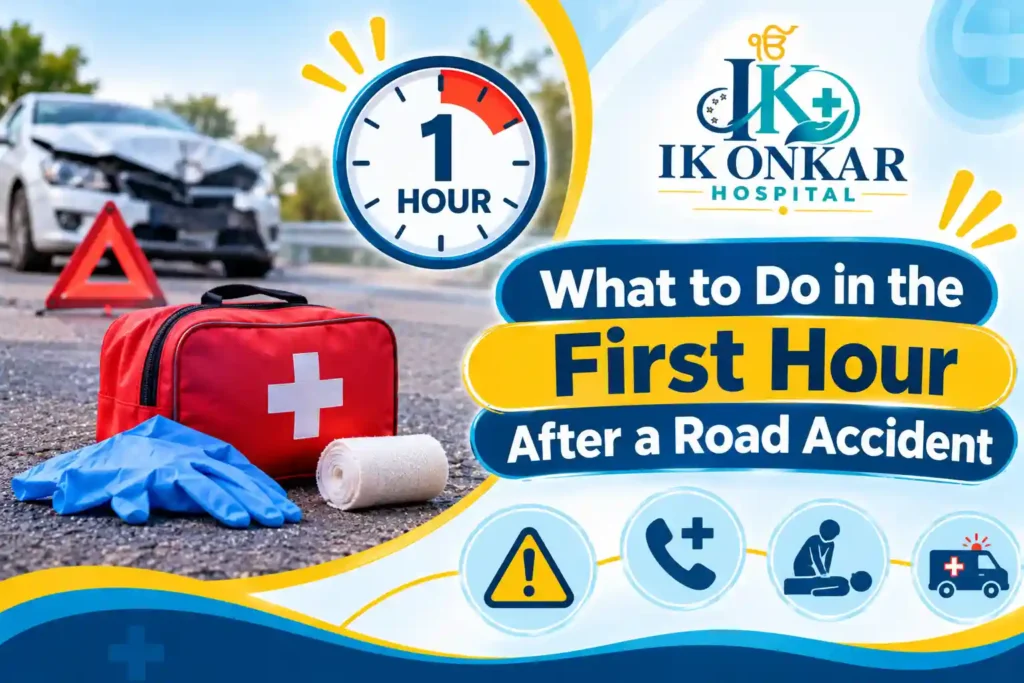
A road accident can leave victims and families confused. Knowing what to do after a road accident helps you act fast and stay safe. In fact, the first few minutes matter a lot. Quick action can protect an injured person and bring emergency medical assistance sooner.
This guide explains road accident first aid, warning signs, and common mistakes. It also shows where to find emergency trauma care in Faridkot. Therefore, use it as a simple checklist in a crisis.
Please remember one thing. A person may look fine and still have a serious injury. For example, they may have a head injury or internal bleeding. So never assume someone is safe because they can talk or walk.
What to Do After a Road Accident: Immediate Steps
Stay calm and follow these steps. Above all, do not put yourself in danger while you help.
1. Make the Accident Scene Safe
Crowds gather fast at an accident. But the first job is to make the area safe. Look for fire, smoke, leaking fuel, or loose electrical wires. Next, move away from fast traffic. Then switch on your hazard lights if you can. Warn other drivers only when it is safe. After that, ask bystanders to stay back.
Never go near a burning or unstable vehicle. Likewise, do not stand in the path of moving traffic. If you get hurt, you cannot help anyone else.
2. Call 112 for Emergency Medical Assistance
Call 112 if anyone has a serious injury. This is India’s national emergency number. You can also call a local ambulance. Do not wait to check every injury first. Emergency medical assistance works best when it starts early.
Give the operator clear details. First, share the exact location and a nearby landmark. Then say how many people are hurt. Mention if anyone is unconscious, bleeding heavily, or struggling to breathe. Also tell them if someone is trapped or if there is fire. Meanwhile, ask another person to call if others are around. Finally, follow the operator’s instructions.
3. Check Responsiveness and Breathing
If the area is safe, speak to the person. Ask, “Can you hear me?” Then watch their breathing. Check for no response, abnormal breathing, heavy bleeding, or sudden confusion.
If the person does not respond and is not breathing normally, call 112 at once. After that, follow the operator’s CPR instructions. Start CPR if you are trained. However, if the person is breathing but badly hurt, keep them still. Meanwhile, keep checking their condition until help arrives.
4. Control Severe Bleeding
Heavy bleeding needs quick action. First, press a clean cloth firmly on the wound. Keep the pressure steady. Do not lift the cloth again and again to look. Glass or metal may be stuck in the wound. In that case, leave it in place and press around it. Also, wear gloves if you have them. Above all, do not delay the ambulance while you treat the bleeding.
5. Avoid Unnecessary Movement
A crash can hurt the head, neck, back, or pelvis. Often there are no visible signs. So do not pull the person out of the vehicle. Likewise, do not ask them to stand or walk. If you suspect a neck or spine injury, keep them in the same position.
Also, do not remove a motorcyclist’s helmet without need. Wrong removal can make a head or neck injury worse. Move the person only if there is immediate danger, such as fire or oncoming traffic. In that case, get help and avoid twisting the body.
Road Accident First Aid: Do’s and Don’ts
Road accident first aid is temporary support. Therefore, it does not replace a doctor’s care.
Here is what you should do. First, check that the scene is safe. Next, call 112 for serious injuries. Then check breathing and responsiveness. Press firmly on bleeding wounds. Keep the person still, warm, and calm. Finally, follow the operator’s advice.
Now let us look at what to avoid. Avoid entering an unsafe area. Never delay the emergency call. Please do not treat an unconscious person as if they are sleeping. Instead, leave embedded objects in place.
In addition, do not give food, water, alcohol, or medicine to a seriously injured person. They may need urgent procedures, and swallowing may be unsafe. Likewise, do not straighten a broken limb or massage an injured area.
First Aid for Accident Victims While You Wait for the Ambulance
After you call for help, stay with the injured person if it is safe. First aid for accident victims is simple while you wait. Moreover, this part of what to do after a road accident is about comfort and close watching.
Speak calmly and reassure them. Then cover them with a blanket or clothing to keep them warm. Watch their breathing and responsiveness. Keep pressing on any bleeding wound. Also, ask someone to guide the ambulance to the spot. In addition, clear the road for the responders.
If the condition changes, tell the operator. For example, mention any vomiting, seizure, loss of consciousness, or breathing trouble. Never leave the person alone unless you face danger.
What to Do After a Car Accident
Many crashes involve cars. So here is what to do after a car accident in simple steps.
First, switch off the engine and turn on the hazard lights. Next, check yourself and your passengers for injuries. Do not rush out of the car onto a busy road. If you can leave safely, move to a safe spot. After that, call 112. Then ask for medical help for anyone in pain, even if the injury looks mild. Once everyone is safe, note the vehicle numbers and take photos. Finally, report the accident to the police.
Serious Road Accident Injury Symptoms to Watch For
Some injuries are hidden after a crash. A person may seem stable but still have a serious problem. Therefore, seek urgent care if you notice any warning sign below.
Head and Brain Injuries
Loss of consciousness, even briefly, is a warning sign. So are severe headache, repeated vomiting, confusion, and seizures. Trouble speaking or walking also needs attention. Likewise, blood or clear fluid from the nose or ears is serious. In such cases, do not wait for symptoms to get worse.
Internal Bleeding and Shock
Internal bleeding may show no blood outside. However, it can follow a blow to the chest, belly, or pelvis. Watch for pale, cold, or clammy skin. Dizziness, fainting, and a weak, fast pulse are also signs. Growing belly pain or swelling needs urgent care too. Do not press deeply on the belly. Instead, wait for trained help.
Chest and Abdominal Injuries
A crash can injure the ribs, lungs, and organs in the belly. Look for chest pain, trouble breathing, or pain that grows when breathing. In addition, belly tenderness, swelling, or coughing blood need urgent care. Even without a visible wound, severe pain after a crash is serious.
Fractures and Spinal Injuries
A fracture is a broken or cracked bone. It may cause pain, swelling, bruising, or a bent limb. Spinal injury signs include neck or back pain, tingling, numbness, and weakness in the arms or legs. Loss of bladder or bowel control after trauma is another sign. Because of this, avoid moving the person. Instead, wait for trained help.
Road Accident Injury Treatment at the Hospital
Once the patient reaches the hospital, the emergency team checks breathing, circulation, and alertness. Doctors often use the ABCDE method:
- Airway: they check that the airway is open.
- Breathing: they check breathing and oxygen levels.
- Circulation: they look for bleeding and shock.
- Disability: they check alertness and nerve function.
- Exposure: they examine the body for injuries and keep the patient warm.
Depending on the case, doctors may order X-rays, blood tests, ultrasound, or CT scans. Road accident injury treatment depends on the type and severity of the injury. For instance, some patients need wound care, a splint, or observation. Others need surgery or intensive care. However, not every patient needs an operation or ICU. The care team decides after examination and tests.
Remember, what to do after a road accident does not end at the scene. Hospital care is the next key step.
Why Early Medical Assessment Matters
Some injuries show up only after some time. For instance, a person may feel mild pain at first. Later, they may develop signs of head injury or internal bleeding. Therefore, early checks help doctors find hidden injuries. They also decide whether imaging or treatment is needed.
What to do after a road accident also includes getting a check-up, even when you feel fine. This matters most after a blow to the head, loss of consciousness, or new symptoms.
The term “Golden Hour” stresses quick care in trauma. However, it is not a strict deadline. In short, the message is clear. Do not delay emergency medical assistance after a serious accident.
Emergency Trauma Care in Faridkot at Ik Onkar Hospital
Families often need to know where to go after a crash. Therefore, knowing what to do after a road accident includes knowing where to seek help. Ik Onkar Hospital offers emergency trauma care in Faridkot at its Talwandi Road location.
The address is the Former Dashmesh Hospital Building, Talwandi Road, Faridkot, Punjab, India. Also, you can call the hospital for directions and details on emergency assessment.
Eligible patients may ask about cashless treatment under approved government health schemes. However, cover and approval depend on scheme rules and the patient’s condition. So do not waste time checking a health card or old records in a serious accident. Instead, call 112 first and follow the instructions.
To learn more, read about Emergency and Trauma Care at Ik Onkar Hospital or contact the hospital for directions.
Conclusion
Knowing what to do after a road accident can help you respond safely in an emergency. First, make the scene safe. Then call 112, check breathing, and control heavy bleeding. Also, avoid moving the injured person without need.
Next, watch for signs of head injury, internal bleeding, fractures, and spinal damage. Remember that road accident first aid is only temporary support. It never replaces a doctor’s care.
For emergency trauma care in Faridkot, contact Ik Onkar Hospital. In a major accident, never delay emergency medical assistance.
This article gives general first aid information. It does not replace first aid training, the operator’s advice, or a doctor’s assessment.
Stay Connected with Ikonkar Hospital
Stay connected with Ikonkar Hospital for healthcare updates, health awareness information, patient care guidance, and useful wellness tips. Visit our website to learn more about our hospital and services. Follow Ikonkar Hospital on Facebook and Instagram for the latest health updates, hospital news, and informative healthcare content.