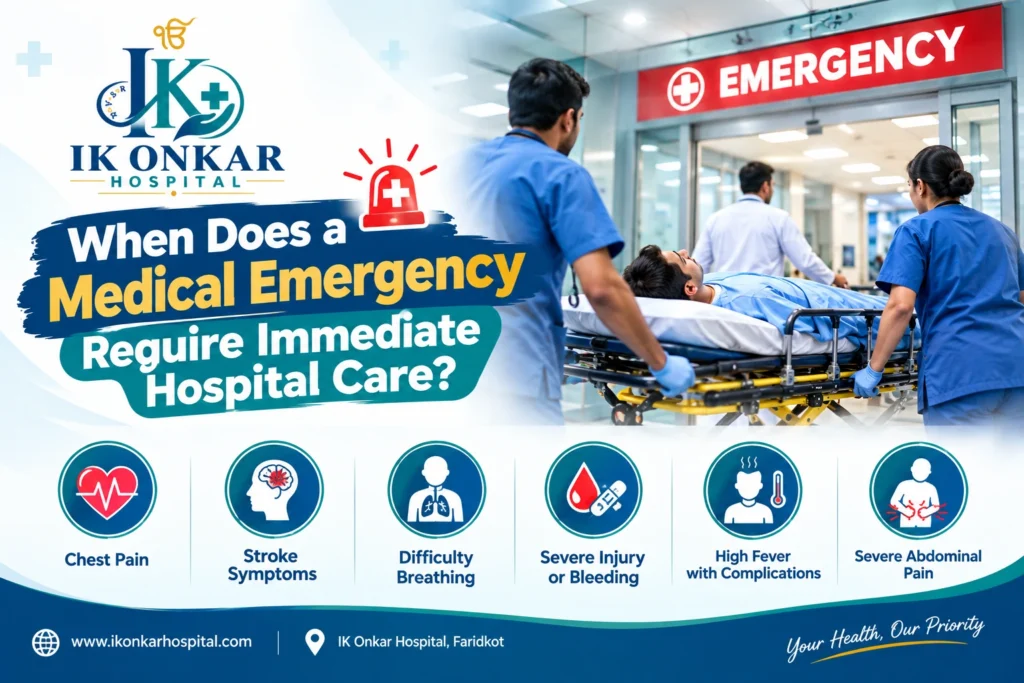
A medical emergency is a sudden illness or injury. It needs quick treatment. Therefore, some emergency symptoms should never be ignored. For example, severe breathing trouble, chest pain, sudden weakness, fainting, heavy bleeding, and stroke signs all need fast action.
It also helps to know which problems can wait. As a result, families can get urgent medical care when time matters.
What Is a Medical Emergency?
- A medical emergency is a case where delay can put life at serious risk.
- It can be a sudden illness, a bad injury, or a breathing problem. Similarly, it can be a heart problem, a nerve problem, or a severe allergy.
- Hospitals use triage to decide who needs help first. Therefore, patients in danger are seen right away.
- The World Health Organization says emergency care is time-sensitive. In fact, it covers heart attacks, strokes, severe infections, asthma attacks, and major injuries.
Which Emergency Symptoms Point to a Medical Emergency?
Some emergency symptoms need extra care because they can signal a serious problem. However, symptoms alone cannot show the cause. For this reason, a doctor’s check is often needed.
1. Chest Pain or Pressure
- Chest pain, pressure, or squeezing needs quick help, especially with other symptoms.
- First, watch for pain that spreads to the arm, shoulder, neck, jaw, or back.
- Also, look for shortness of breath, cold sweat, nausea, or vomiting.
- In addition, the person may feel weak or faint.
- These signs can occur in a heart attack. However, chest pain can have other causes too.
- So, do not try to guess the cause when the pain is sudden or severe.
2. Severe Difficulty Breathing
- Breathing trouble becomes a medical emergency when the person struggles for air.
- For example, the person may not be able to speak in full sentences.
- Moreover, the skin or lips may turn blue or grey.
- The person may also feel confused or pass out.
- Causes include a bad asthma attack, a severe allergy, or a heart or lung problem.
- Therefore, if breathing is very hard, get help right away.
3. Sudden Signs of Stroke
- A stroke is a medical emergency because it suddenly changes how the brain works. For this reason, it needs fast care.
- Watch for sudden weakness or numbness, especially on one side of the body.
- Also, check for a drooping face or trouble with speech.
- In addition, sudden vision loss, poor balance, or a severe headache can be warning signs.
- The BE FAST method can help you spot a stroke. It stands for balance, eyes, face, arms, speech, and time.
- First, note when the symptoms began. Then, get help right away.
- Even if the symptoms fade, still see a doctor. This is because a short episode can be a mini-stroke.
4. Fainting or Severe Confusion
- Fainting with other worrying signs needs urgent care. So does sudden, severe confusion.
- The causes are many. For instance, they include problems of the brain, heart, or blood sugar.
- Infections can also be a cause.
- Therefore, a person who does not respond normally should see a doctor right away.
5. Seizures
- Some seizures are a medical emergency, but others pass quickly.
- Get help if a seizure lasts a long time or repeats before the person recovers.
- Likewise, get help if it causes breathing trouble or comes with a serious injury.
- Also, seek help if the person stays unresponsive.
- Never put anything in the person’s mouth during a seizure.
- Instead, move nearby objects away and call for help.
6. Severe Bleeding
- Heavy bleeding can become a medical emergency very quickly.
- Get help if the bleeding is heavy or hard to stop.
- Likewise, seek help when blood loss follows a major injury or the wound is deep.
- Moreover, a person who turns pale, weak, or faint needs care at once.
- Meanwhile, give first aid and arrange a ride to the hospital.
- Finally, do not wait if the bleeding does not stop.
7. Severe Allergic Reactions
- A severe allergy can develop fast. In addition, it can affect breathing and blood pressure.
- For example, the person may have trouble breathing or swelling of the lips, tongue, or face.
- Similarly, hives with other worrying symptoms can be a sign.
- Severe dizziness or sudden collapse can also occur.
- As a result, all of these need urgent medical care.
8. Serious Injuries
- Major injuries need hospital care, even if the person looks fine at first.
- For example, bad road accidents, big falls, and head injuries can be dangerous.
- Likewise, deep wounds, serious burns, and severe fractures need quick care.
- Any injury with fainting is also a reason to go to the hospital.
- Some injuries inside the body are not visible at first. Therefore, a doctor should check the person after any major injury.
When Should You Seek Urgent Medical Care?
- Seek urgent medical care when emergency symptoms are serious or getting worse fast.
- This is especially true for sudden breathing trouble, nerve problems, or severe pain.
- If you are unsure, look at how severe and how fast the symptoms are. Instead of waiting, act before the danger is clear.
- Mild and steady symptoms can often wait for a routine visit. On the other hand, a sudden or severe medical emergency may need hospital care right away.
Medical Emergency in Children
Children can become very sick in a short time. For this reason, parents often find it hard to judge how serious the problem is.
- Seek help fast if a child has severe breathing trouble or looks blue, grey, or very pale.
- Similarly, get help if the child does not respond or is very hard to wake.
- Also, a seizure, heavy bleeding, or a serious injury needs urgent care.
- In addition, sudden weakness, strange behaviour, or signs of a severe allergy are warning signs.
- Do not wait for the child to explain the pain. Instead, watch for changes in breathing, behaviour, movement, and looks.
- If a child looks very unwell, get help quickly.
What Should You Do During a Medical Emergency?
Stay calm and act fast. Follow these steps:
- Spot the warning signs. First, look for sudden changes in breathing, speech, or movement.
- Call for help. Next, if life is at risk, call your local emergency number or go to a hospital.
- Avoid delays. Do not wait for severe symptoms to pass, because time matters.
- Share key details. Then, tell the doctors when the symptoms started. Also, mention any known conditions, medicines, allergies, and recent injuries.
- Follow the doctor’s advice. Finally, do not give medicine, food, or water if it is unsafe.
How Do Emergency Teams Assess Patients?
- First, the team checks the patient’s condition. Then, they decide how urgent the case is.
- Doctors may check breathing, heart rate, and blood pressure. In addition, they check oxygen levels and alertness.
- They also ask about the symptoms and the patient’s health history.
- Depending on the case, they may order blood tests, scans, or an ECG.
- The tests differ from patient to patient. However, the first goal is the same. Doctors deal with the biggest danger first, and then they plan further care.
When Should You Visit an Emergency Hospital in Faridkot?
- People in Faridkot and nearby areas should know where to go in a medical emergency.
- If you need an emergency hospital in Faridkot, Ik Onkar Hospital is at the Former Dashmesh Hospital Building, Talwandi Road, Faridkot, Punjab.
- In a possible emergency, a quick check by doctors matters more than guessing at home.
- Therefore, seek help without delay for severe breathing trouble, suspected stroke, or strong chest pain.
- Likewise, do not wait in case of fainting, heavy bleeding, or a major injury.
Conclusion
- Knowing the signs of a medical emergency helps families get urgent medical care when time matters.
- Breathing trouble, chest symptoms, stroke signs, fainting, seizures, heavy bleeding, severe allergies, and major injuries all need quick care.
- However, an online article cannot replace a doctor. So, do not try to diagnose a serious problem on your own.
- If someone looks very unwell or is getting worse fast, get help right away.
- Finally, knowing the nearest emergency hospital in Faridkot can reduce delays in a serious case.
Frequently Asked Questions
What is considered a medical emergency?
A medical emergency is a sudden illness, injury, or health problem that may threaten life or cause serious harm if treatment is delayed. Examples include severe breathing difficulty, suspected stroke, serious chest pain, major bleeding, loss of consciousness, seizures, severe allergic reactions, and major trauma.
What emergency symptoms should never be ignored?
Severe difficulty breathing, sudden weakness on one side, facial drooping, speech problems, loss of consciousness, severe chest pain, uncontrolled bleeding, seizures, and serious injuries should be treated as warning signs requiring prompt medical assessment.
When should I go to the hospital for chest pain?
Seek immediate medical evaluation for sudden, severe, persistent, or unexplained chest pain, particularly when it occurs with shortness of breath, sweating, nausea, faintness, weakness, or pain spreading to the arm, jaw, neck, back, or shoulder.
When does difficulty breathing become an emergency?
Difficulty breathing becomes particularly concerning when it is severe or sudden, prevents normal speaking, is associated with blue or grey skin or lips, confusion, fainting, severe chest symptoms, or rapid deterioration. Immediate emergency assessment may be necessary.
Should children with severe symptoms receive emergency care?
Yes. Children with severe breathing problems, seizures, unresponsiveness, serious injuries, severe bleeding, severe allergic reactions, or rapid deterioration should receive prompt emergency medical assessment.
What should I do if I am unsure whether symptoms are an emergency?
If symptoms are sudden, severe, rapidly worsening, or involve breathing, consciousness, chest symptoms, severe bleeding, or neurological changes, do not wait for them to become worse. Seek urgent professional medical assessment.