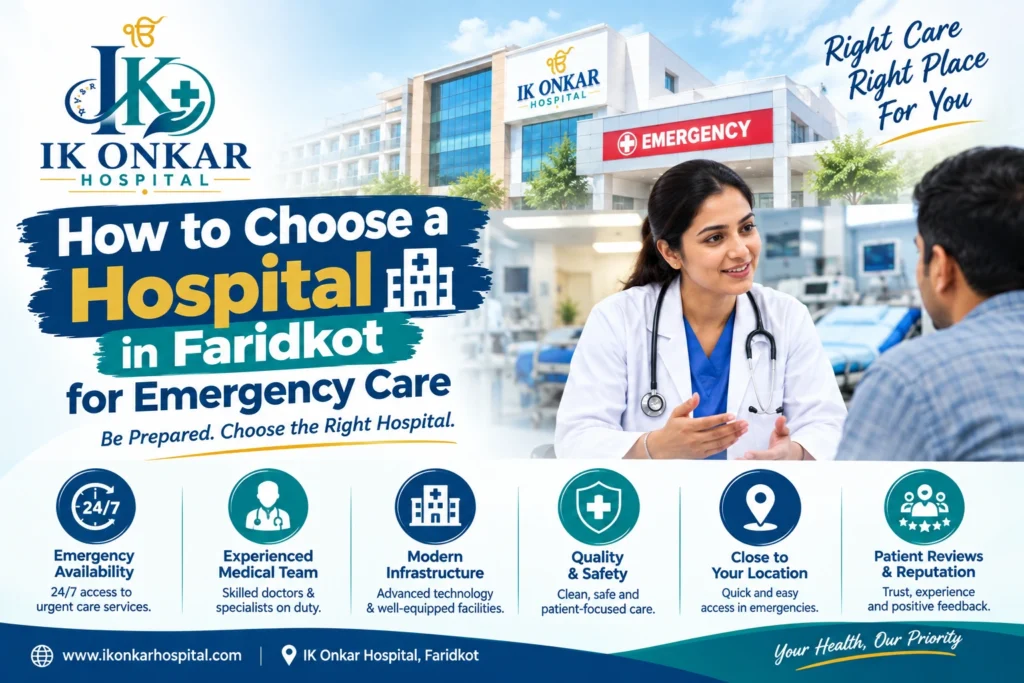
When a serious illness, accident, or sudden medical problem occurs, choosing the right hospital in Faridkot can become an urgent decision. Emergency care is time-sensitive, so families should look beyond general reputation and consider practical factors such as 24×7 availability, trauma care, critical-care support, specialist access, facilities, and location.
A suitable emergency hospital should be able to assess the patient’s condition quickly, identify potentially life-threatening problems, provide initial stabilization, and arrange the appropriate next level of treatment when required. The World Health Organization emphasizes systematic early assessment and management for time-sensitive illness and injury because delays can affect outcomes.
What Should You Look for in a Hospital in Faridkot?
There is no single feature that makes a hospital appropriate for every emergency. The right choice depends on the patient’s condition and the level of care required.
However, several practical factors can help families evaluate an emergency hospital in Faridkot.
1. 24×7 Emergency Availability
Emergencies do not follow regular clinic hours. A hospital providing round-the-clock emergency care can be important when a patient develops a serious condition at night, during a weekend, or on a holiday.
Before choosing a hospital, check whether its emergency service operates 24 hours a day and whether the emergency team handles urgent medical and accident cases.
For patients with potentially life-threatening symptoms, emergency assessment should not be delayed simply because a routine appointment is unavailable.
2. Emergency and Trauma Care
Trauma care is particularly important after road accidents, falls, workplace injuries, fractures, head injuries, or other significant physical trauma.
A hospital providing trauma care should have an organized process for assessing injured patients and identifying conditions that may require urgent intervention. WHO emergency-care guidance includes trauma, breathing difficulties, shock, and altered mental status among time-sensitive presentations requiring systematic assessment.
When evaluating a hospital, ask:
- Does it provide emergency trauma care?
- Is emergency care available 24×7?
- Can seriously injured patients receive prompt assessment?
- Is critical-care support available when required?
- Is surgical support available when clinically appropriate?
These questions can help families understand whether a facility matches their emergency-care needs.
3. Critical Care Support
Some emergency patients need more than initial treatment. A person who is severely ill or unstable may require close monitoring and intensive medical support.
For this reason, families may also consider whether the hospital has critical-care facilities and trained staff to monitor patients who become seriously ill.
Ik Onkar Hospital’s website lists a dedicated MICU for critically ill patients, with continuous specialist supervision, along with 24×7 emergency services.
The availability of critical-care support can be especially relevant when an emergency involves severe infection, breathing difficulty, shock, altered consciousness, or other serious conditions.
4. Specialist and Surgical Support
Emergency patients may have different medical needs. An accident could involve bones, joints, soft tissues, or internal injuries, while a medical emergency may require assessment by a different specialist.
Therefore, consider whether the hospital has relevant departments and specialist support for the emergencies it handles.
Ik Onkar Hospital lists departments including General & Laparoscopic Surgery, Gynaecology & Obstetrics, Orthopedics & Trauma, Pediatrics & Neonatology, Critical Care & Anaesthesia, and Emergency & Trauma Medicine.
This type of multidisciplinary setup can help patients access appropriate clinical expertise when an emergency requires more than initial assessment.
5. Diagnostic and Monitoring Facilities
Emergency treatment often begins with clinical assessment. Depending on the patient’s symptoms and condition, doctors may also require diagnostic tests or ongoing monitoring to understand what is happening.
When comparing a hospital, ask what diagnostic and monitoring facilities are available and whether they support the emergency services provided there.
It is also important to understand that not every patient needs the same tests. The treating healthcare professional decides which investigations are clinically appropriate based on the patient’s symptoms, examination, and medical history.
6. Location and Accessibility
During an emergency, distance and accessibility matter.
A hospital that is reasonably accessible from your home, workplace, school, or usual travel route may be easier to reach when urgent care is required.
For families in Faridkot, knowing the location of the emergency hospital in advance can reduce confusion during a stressful situation.
Ik Onkar Hospital is located at the Former Dashmesh Hospital Building, Talwandi Road, Faridkot, Punjab 151203. Its website states that 24×7 emergency care is available.
Families can save the hospital’s contact details and directions before an emergency occurs.
7. Insurance and Government Health Schemes
Healthcare costs can be another practical consideration when choosing a hospital.
If you or a family member has health insurance or an eligible government health scheme, check whether the hospital accepts the relevant scheme and which treatments are covered.
Ik Onkar Hospital’s website states that it accepts eligible Ayushman Bharat (PM-JAY) and Mukh Mantri Sehat Yojana cards. Patients should confirm current eligibility, coverage, and applicable treatment conditions directly with the hospital before relying on a particular benefit.
When Should You Seek Emergency Medical Care?
Emergency care may be appropriate when a person’s condition appears potentially life-threatening or is rapidly worsening.
Examples of warning signs can include:
- Severe difficulty breathing
- Loss of consciousness or inability to wake normally
- Sudden confusion or major change in mental status
- Severe or persistent chest pain
- Signs of a stroke, such as sudden weakness on one side or difficulty speaking
- Serious bleeding
- Major injuries after an accident
- Severe burns or significant trauma
- Convulsions or seizures
- Signs of shock, such as severe weakness, clammy skin, or fainting
WHO identifies symptoms such as difficulty breathing, shock, and altered mental status as important presentations in emergency care. Sudden stroke symptoms also require immediate medical attention.
If someone has symptoms that could represent a life-threatening emergency, seek immediate medical help rather than waiting for symptoms to resolve.
What Happens During Emergency Assessment?
Emergency care generally begins with a rapid assessment of the patient’s condition. Healthcare professionals look for problems that could threaten breathing, circulation, consciousness, or other vital functions.
The exact evaluation depends on the patient’s symptoms and medical history. A patient with an accident-related injury may require trauma assessment, while someone with breathing difficulty may require a different evaluation.
The purpose is not simply to determine a diagnosis. Emergency teams also prioritize problems that require immediate treatment or stabilization.
WHO’s Basic Emergency Care framework emphasizes systematic assessment and management of acutely ill and injured patients, particularly when early intervention may be important.
How Families Can Prepare for a Medical Emergency
You cannot predict every emergency, but basic preparation can make the process easier.
Keep the following information readily available:
- Patient’s full name and age
- Current medicines
- Known allergies
- Existing medical conditions
- Previous major surgeries or hospitalizations
- Relevant medical reports
- Insurance or government health-scheme details
- Emergency contact numbers
- Preferred nearby hospitals
It is also useful to know the route to a nearby emergency hospital before an emergency happens.
In Faridkot, the district administration lists 108 as the ambulance helpline. In a serious emergency, use the appropriate emergency transport or local emergency service rather than attempting to manage a life-threatening situation at home.
Emergency Care at Ik Onkar Hospital, Faridkot
Ik Onkar Hospital is located on Talwandi Road at the former Dashmesh Hospital building in Faridkot.
According to the hospital’s current website, its emergency and trauma services are available 24×7 for critical and accident cases. The hospital also lists a dedicated MICU for critically ill patients, NICU services for newborns, Trauma & Accident Care, modular operation theatres, and departments including Orthopedics & Trauma, General & Laparoscopic Surgery, Pediatrics & Neonatology, Critical Care & Anaesthesia, and Emergency & Trauma Medicine.
For local families, having this information in advance can make it easier to identify an appropriate healthcare facility when urgent medical attention is needed.
Patients and families should still understand that the appropriate facility depends on the nature and severity of the emergency. In some situations, a patient may need transfer to another center with a particular subspecialty or advanced intervention.
Conclusion
Choosing a hospital in Faridkot for emergency care should involve more than simply looking at the hospital’s name. Consider 24×7 emergency availability, trauma-care capability, critical-care support, relevant specialists, diagnostic facilities, accessibility, and applicable healthcare schemes.
For families in Faridkot, knowing where to seek emergency care before an urgent situation occurs can save valuable time. If a person develops severe breathing difficulty, chest pain, sudden neurological symptoms, loss of consciousness, serious bleeding, major trauma, or another potentially life-threatening problem, seek immediate medical attention.
Ik Onkar Hospital on Talwandi Road provides 24×7 emergency and trauma care, with critical-care and other hospital services listed on its website.
Medical disclaimer: This article provides general health information and is not a substitute for examination, diagnosis, or individualized medical advice from a qualified healthcare professional.