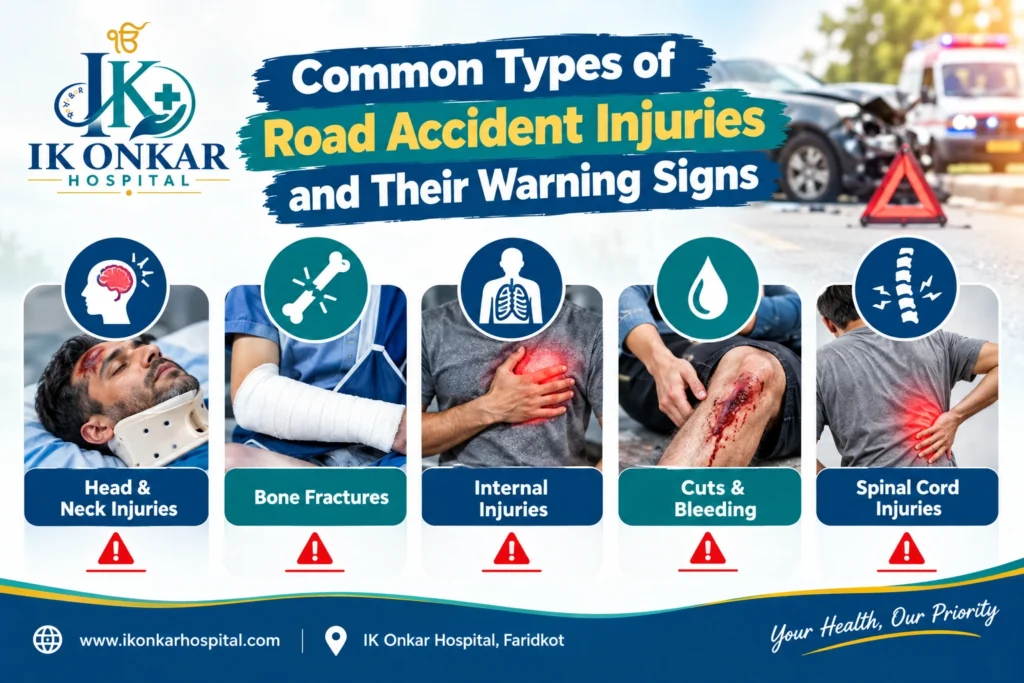
Road accident injuries can be mild or serious. Some are small cuts and bruises. Others are fractures, head injuries, spine injuries, or internal injuries. While some problems show up at once, others may appear only after hours or even days.
Knowing the common types of road accident injuries helps families spot warning signs early. This is especially important when there is severe pain, a head impact, or trouble moving. Likewise, it matters if the person has trouble breathing, faints, or seems less alert.
What Are Road Accident Injuries?
Road accident injuries are physical injuries from a traffic collision. The impact and the sudden jerk of the body cause them. As a result, they can harm bones, muscles, joints, the brain, the spine, the chest, the belly, or the skin.
How serious the injury is depends on a few things. For example, the force of the crash matters. So does the body part that was hit. Also, a seat belt or helmet can make a big difference. In addition, some people have more than one injury.
Besides that, a person can be badly hurt without a large wound. Therefore, doctors look closely at the symptoms and at how the crash happened.
Common Types of Injuries After a Road Accident
Fractures and Broken Bones
Fracture injuries are common after a serious crash. A fracture means a bone is partly or fully broken. Accident-related fractures can affect the:
- Arms and wrists
- Legs and ankles
- Shoulder
- Collarbone
- Ribs
- Pelvis
- Spine
- Other bones
Common signs include strong pain, swelling, bruising, and tenderness. Also, the person may not be able to use the body part. Sometimes the limb looks bent or out of place.
However, not every fracture looks obvious. So a doctor may advise an X-ray after checking the injury.
Head Injuries and Concussion
A hard blow or jolt can cause a head injury. Doctors call a serious one a traumatic brain injury (TBI). A concussion is a mild form of TBI. Because of this, it can affect thinking, memory, balance, mood, vision, and sleep.
Possible symptoms include:
- Headache
- Dizziness
- Nausea or vomiting
- Poor balance
- Confusion
- Trouble focusing
- Memory problems
- Unusual tiredness
- Vision problems
Symptoms do not always start right away. In fact, some appear later. Therefore, never ignore a change in the person’s condition after a head impact.
Cuts, Abrasions and Lacerations
An abrasion happens when the skin scrapes against a rough surface. A laceration, on the other hand, is a cut or tear in the skin. It can be shallow or deep.
These wounds often happen when a person falls on the road. Similarly, they can happen when the body hits part of the vehicle or sharp broken material.
A doctor should check the wound if it is deep, dirty, or bleeding heavily. Likewise, medical help is needed if nearby parts of the body may be damaged.
Sprains, Strains and Soft Tissue Injuries
Not every accident causes a broken bone. Muscles, tendons, and ligaments can also get hurt. A sprain affects a ligament, while a strain affects a muscle or tendon.
These injuries may cause:
- Pain
- Swelling
- Bruising
- Stiffness
- Less movement
- Tenderness
Moreover, the neck and shoulders often hurt after a sudden stop or jolt.
Neck and Back Injuries
The force of a crash can hurt the neck and back. Mild cases involve only muscles. However, severe cases can damage the spine or spinal cord.
Pay close attention to these signs: severe neck or back pain, weakness, numbness, trouble walking, or a change in feeling.
If a spine injury is possible, do not move the person without need. Instead, wait for trained emergency help.
Chest and Rib Injuries
A crash can bruise the chest or break the ribs. As a result, the person may have chest pain, tenderness, or pain while breathing. Breathing may also become hard.
For this reason, get chest symptoms checked quickly after a serious crash. After all, an injury inside the chest cannot be judged from the outside.
Abdominal and Internal Injuries
A hard blow can hurt organs inside the belly. This can happen even when there is little or no bleeding outside.
Warning signs include:
- Worsening belly pain
- Tender or swollen belly
- Dizziness or weakness
- Fainting
- Vomiting
- Trouble breathing
- Confusion or feeling very unwell
Internal injuries are hard to spot without a check-up. So a doctor may decide on observation, blood tests, or scans.
Dislocations
A dislocation happens when a joint is forced out of place. The shoulder, elbow, hip, knee, and fingers can all be affected.
It may cause severe pain, swelling, and trouble moving the joint. Also, the joint may look odd.
Never try to push the joint back at home. Instead, let a doctor treat it.
What Symptoms Can Appear After Accident Trauma?
Symptoms depend on the type and severity of the injury. Common signs of accident trauma include:
- Pain or tenderness
- Swelling
- Bruising
- Bleeding
- Reduced movement
- Trouble walking
- Headache
- Dizziness
- Nausea or vomiting
- Confusion
- Numbness or tingling
- Weakness
- Trouble breathing
- Loss of consciousness
A person may have more than one injury. For instance, someone may have a fracture and a head injury together.
Besides this, head injury symptoms can show up late. Therefore, feeling fine right after a crash does not mean you are safe.
How Are Road Accident Injuries Diagnosed?
First, the doctor asks how the accident happened. Then the doctor checks symptoms, vital signs, and the body. Finally, any change in the person’s condition is noted.
Depending on the injury, tests may include:
- Physical examination
- Nerve and brain function check
- X-rays
- CT scans
- Other scans, when needed
- Blood tests or other tests, when needed
However, not every patient needs every test. The choice depends on symptoms, age, medical history, and the type of injury.
For a suspected mild brain injury, the doctor’s check is most important. Brain scans, in contrast, are used only when there are signs of a more serious problem.
How Are Accident Injuries Treated?
Treatment depends on the injury and how serious it is. Possible steps include:
- Cleaning and caring for wounds
- Managing pain and swelling
- Keeping an injured limb still
- Treating fractures
- Treating dislocations
- Observation and monitoring
- Treating head injuries
- Care for more serious trauma
- Follow-up care and rehabilitation
A fracture may need a cast, a splint, or other bone treatment. Moreover, complex injuries may need a specialist or hospital care.
So the doctor should decide the treatment after a proper check-up. Symptoms read online are not enough.
When Should You See a Doctor After a Road Accident?
See a doctor if the accident causes strong pain, swelling, or trouble moving. Likewise, get help for a suspected fracture, a head impact, or symptoms that last. Also go if anything worries you or your family.
Get quick medical help, especially if there is:
- Loss of consciousness
- A headache that lasts or gets worse
- Repeated vomiting
- Confusion or odd behavior
- Severe neck or back pain
- Weakness or numbness
- Trouble walking
- Heavy bleeding
- Chest pain or trouble breathing
- Severe belly pain
- A suspected fracture or dislocation
After that, the doctor can decide on more observation, scans, treatment, or follow-up.
When Is a Road Accident Injury an Emergency?
Some signs need emergency care at once. After a head injury, go to the emergency room if there is:
- A worsening headache
- Repeated vomiting
- Seizures
- Growing confusion
- Unusual sleepiness or trouble waking up
- Slurred speech
- Weakness or numbness
- Poor coordination
- Unequal pupils
These can be signs of a serious brain injury.
Emergency care is also needed for severe breathing trouble, bleeding that will not stop, or a suspected serious spine injury. Similarly, go at once if the person faints or shows signs of severe shock.
Do not wait for symptoms to get severe. This is especially true after a major crash or when the person is getting worse.
What Should Families Watch for After an Accident?
Families should watch for changes after the crash. Look for changes in:
- Alertness
- Behavior
- Speech
- Walking or balance
- Memory
- Vision
- Pain level
- Breathing
- Use of an injured limb
This matters most after a head injury, because some symptoms appear late.
Children also show symptoms differently from adults. Therefore, parents should watch for unusual crying. In addition, they should notice changes in eating, sleep, balance, or play after a head impact.
Road Accident Injury Care in Faridkot
People in Faridkot and nearby areas may need quick medical help after a road accident. Ik Onkar Hospital is at the Former Dashmesh Hospital Building, Talwandi Road, Faridkot, Punjab.
In such a case, the first step is a proper medical check based on how serious the injury is. This can include fractures, soft tissue injuries, head injuries, and other trauma.
Ik Onkar Hospital’s Trauma & Accident Care service supports patients with accident-related injuries. So families looking for an accident hospital in Faridkot can contact the team for care.
However, if the situation is life-threatening, call emergency services at once. Otherwise, valuable time may be lost by relying on online information.
Conclusion
Road accident injuries range from cuts and sprains to fracture injuries, head trauma, spine injuries, and internal injuries. While some are easy to see, others show up later.
Therefore, get quick medical help for severe or worsening pain, nerve symptoms, trouble breathing, fainting, repeated vomiting, or heavy bleeding. Likewise, act fast if you suspect serious trauma.
For people in Faridkot, knowing these warning signs helps families decide when to seek care. Finally, this article gives general health information. It does not replace a check-up or advice from a qualified doctor.