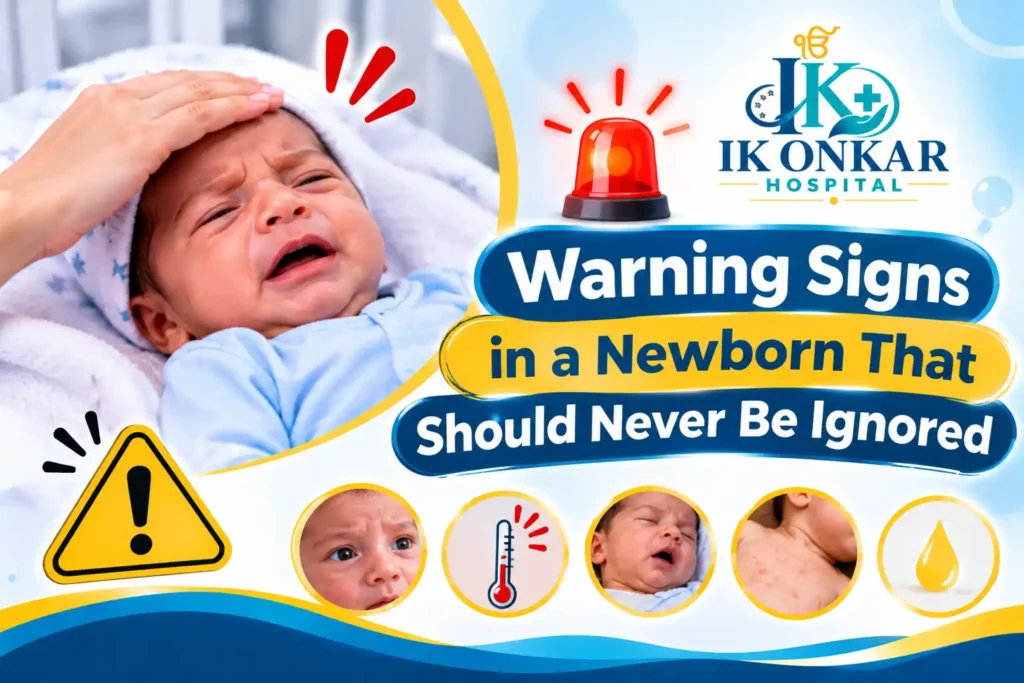
A newborn cannot tell you when something feels wrong. Therefore, parents must watch for changes in breathing, feeding, movement, temperature, and skin colour. Some changes are harmless. However, others can point to a serious problem.
Knowing the danger signs in newborn babies helps you act fast. Newborn warning signs such as breathing trouble, poor feeding, fever, fits, and early jaundice should never be ignored. In this guide, you will learn which warning signs of newborn illness need care, when to rush to the hospital, and where to find newborn care in Faridkot.
Why Should Parents Know the Warning Signs in Newborns?
A sick newborn may not look sick in the way an older child does. Moreover, the baby’s condition can change within hours. Early signs are often small, so they are easy to miss.
For example, a baby may suddenly feed less, move less, or feel too hot or too cold. In such cases, the baby needs a doctor’s check. The World Health Organization lists poor feeding, low activity, fast breathing, fever, fits, early jaundice, yellow palms and soles, and a cold body as key danger signs in newborn babies.
You do not need to find the cause yourself. Instead, your job is to spot the change and get help quickly.
What Are the Danger Signs in Newborn Babies?
The newborn warning signs below need attention. Some are emergencies. Others need a doctor’s check on the same day. If your baby looks very unwell, do not wait.
1. Newborn Breathing Warning Signs
Breathing trouble is one of the most serious danger signs in newborn babies. Watch for these newborn breathing warning signs:
- Very fast breathing, or a change in the breathing pattern
- The chest pulling in below or between the ribs
- Nostrils opening wide with each breath
- A grunting sound with each breath
- Pauses in breathing or gasping
- Blue or grey lips, tongue, or skin
More than 60 breaths in one minute is fast for a newborn. So, if the baby is calm, count the breaths for a full minute. However, do not delay care just to count.
Severe chest pulling, gasping, pauses in breathing, and blue or grey colour are emergency signs. In that case, get medical help at once.
2. Poor Feeding
A baby who suddenly feeds badly may be unwell. Infection, breathing trouble, and low blood sugar can all cause this. Look for these signs:
- Refusing the breast or bottle
- Weak sucking, or trouble latching on
- Much less milk taken than usual
- Falling asleep before the feed ends
- Repeated vomiting of feeds
- Fewer wet nappies than normal
A baby who cannot feed needs a doctor’s check soon. Besides, if the baby is hard to wake or floppy, treat it as an emergency. Also, never force-feed a very sleepy baby, because the milk can go into the lungs.
3. Fever or Low Body Temperature
Both a high and a low temperature can be newborn warning signs. Watch for these:
- Temperature of 38°C or higher
- Very low temperature
- Skin that feels very hot or very cold
- Shivering, or a sudden change in activity
Indian newborn guidelines also treat an underarm temperature of 37.5°C or above, or below 36°C, as a danger sign. Still, readings can vary by method. So, if your baby looks unwell, do not wait for a certain number. Meanwhile, avoid fever medicine, cold baths, or home remedies unless a doctor advises it.
4. Unusual Sleepiness or Less Movement
Newborns sleep a lot. Even so, they should wake for feeds and respond to touch. Be worried if your baby:
- Is much sleepier than usual
- Is hard to wake for feeds
- Moves much less than before
- Feels floppy or weak
- Has a weak or unusual cry
Such changes can mean a serious illness. Therefore, see a doctor at once, especially if the baby also feeds badly or has a fever.
5. Fits or Abnormal Movements
Fits in a newborn are a serious warning sign. They may look like repeated jerking, stiffening, odd eye movements, or sudden blank spells. Some fits are subtle, so they may not look like fits in older children.
If you think your baby is having a fit:
- Get emergency help at once
- Lay the baby on a flat, safe surface
- Keep your hands off the baby’s limbs, and let the movements pass
- Never put anything in the baby’s mouth
- Skip milk, water, and medicine during the fit
- Note how long the fit lasts, if it is safe to do so
6. Warning Signs of Jaundice in Newborns
Jaundice turns the skin and the whites of the eyes yellow. It happens when bilirubin builds up in the blood. Mild jaundice is common in newborns. However, some patterns are not safe.
These are the warning signs of jaundice in newborns:
- Skin or eyes turning yellow within the first 24 hours of birth
- A colour that spreads or gets deeper
- Palms or soles that look yellow
- Poor feeding or extra sleepiness along with jaundice
- Dark urine or pale stools
Jaundice in the first 24 hours, or yellow palms and soles, needs urgent care. Likewise, jaundice with fever, fits, or trouble waking is an emergency.
A doctor can check bilirubin with a skin device or a blood test. Then, the doctor decides on treatment. Phototherapy is often used when treatment is needed. For this reason, do not depend on sunlight or home remedies for jaundice.
7. Infection Near the Umbilical Cord or Skin
Infections in newborns can start in small ways. So, check the cord and skin during daily care. Call a doctor soon if you see:
- Redness spreading around the cord
- Pus or a bad smell from the cord
- Swelling near the navel
- Many pus-filled spots on the skin
- Red, swollen, or sticky eyes
If these signs come with fever, poor feeding, or breathing trouble, go to the hospital at once. In addition, do not apply powder, oil, or any home remedy to the cord unless a doctor says so.
8. Repeated Vomiting or Stomach Problems
A small amount of milk coming back after a feed is common. However, some vomiting is not normal. Get a doctor’s help if your baby has:
- Forceful or repeated vomiting
- Green vomit
- Blood in the vomit or stool
- A swollen belly
- Trouble passing urine
When Is a Newborn’s Condition an Emergency?
Go to the nearest hospital at once if your newborn:
- Is not breathing or is gasping
- Turns blue or grey around the lips or tongue
- Has a fit or does not respond
- Is very hard to wake
- Shows severe breathing trouble with poor feeding or weakness
Other newborn warning signs also need quick care. These include fever, a cold body, fast breathing, and early jaundice. So, do not wait for many signs to appear together. Above all, do not lose time searching online or booking a routine visit.
What Should Parents Do If They Notice Danger Signs in Newborn Babies?
First, stay calm, but act fast. Then, follow these steps:
- Note the change. Write down when it began and what changed.
- Get medical help. Call a doctor or go to the hospital. For severe signs, use emergency services.
- Keep the baby safe. Handle the baby gently if breathing is hard.
- Avoid home treatment. Do not give medicine, honey, water, or herbal items.
- Share key details. Tell the doctor the baby’s age, birth history, feeding pattern, and any temperature readings.
Most importantly, do not delay emergency care to collect details.
How Do Doctors Check a Newborn With Warning Signs?
First, the doctor checks breathing, heart rate, temperature, alertness, and feeding. After that, the doctor may order more tests, such as:
- Oxygen level and heart rate checks
- Blood sugar tests
- Bilirubin tests for jaundice
- Blood tests when infection is a worry
Treatment depends on the baby’s needs. For example, it may include breathing support, warmth, feeding help, fluids, phototherapy, or medicine. If a baby needs higher care, the doctor may refer the baby to a hospital with a NICU.
Can Newborn Illness Be Found Early?
Not every illness can be prevented. Still, regular care helps you spot problems early. These habits help:
- Attend all postnatal check-ups
- Feed the baby as advised
- Watch feeding, activity, and wet nappies
- Keep the baby warm, but not too hot
- Wash your hands before touching the baby
- Follow cord care advice from the doctor
- Keep up with vaccines and newborn screening
Also, before you leave the hospital after delivery, ask the team to explain the newborn warning signs and where to go if they appear at home.
Newborn Care in Faridkot
Families in Faridkot should know where to get a quick check for their baby. Ik Onkar Hospital is in the Former Dashmesh Hospital Building, Talwandi Road, Faridkot, Punjab.
Before you choose a hospital, call and confirm the services. Here are some useful questions:
- Is newborn assessment available now?
- Can the team check breathing trouble, feeding problems, fever, or jaundice?
- What is the plan if the baby needs NICU care?
- How can parents reach emergency help?
However, if your baby has severe symptoms, do not spend time comparing hospitals. Go to the nearest hospital right away.
Conclusion
Knowing the danger signs in newborn babies can help you seek care before a problem becomes serious. Breathing trouble, poor feeding, fever, a cold body, low movement, fits, and early jaundice should never be ignored. Therefore, learn the newborn warning signs and trust your instincts.
Severe newborn breathing warning signs, fits, blue or grey colour, and no response are emergencies. In the same way, the warning signs of jaundice in newborns need a doctor’s check without delay. For families in Faridkot, knowing where to go makes it easier to act with confidence.
This article is for general information only. It does not replace a doctor’s advice or examination.
Stay Connected with Ikonkar Hospital
Stay connected with Ikonkar Hospital for healthcare updates, health awareness information, patient care guidance, and useful wellness tips. Visit our website to learn more about our hospital and services. Follow Ikonkar Hospital on Facebook and Instagram for the latest health updates, hospital news, and informative healthcare content.