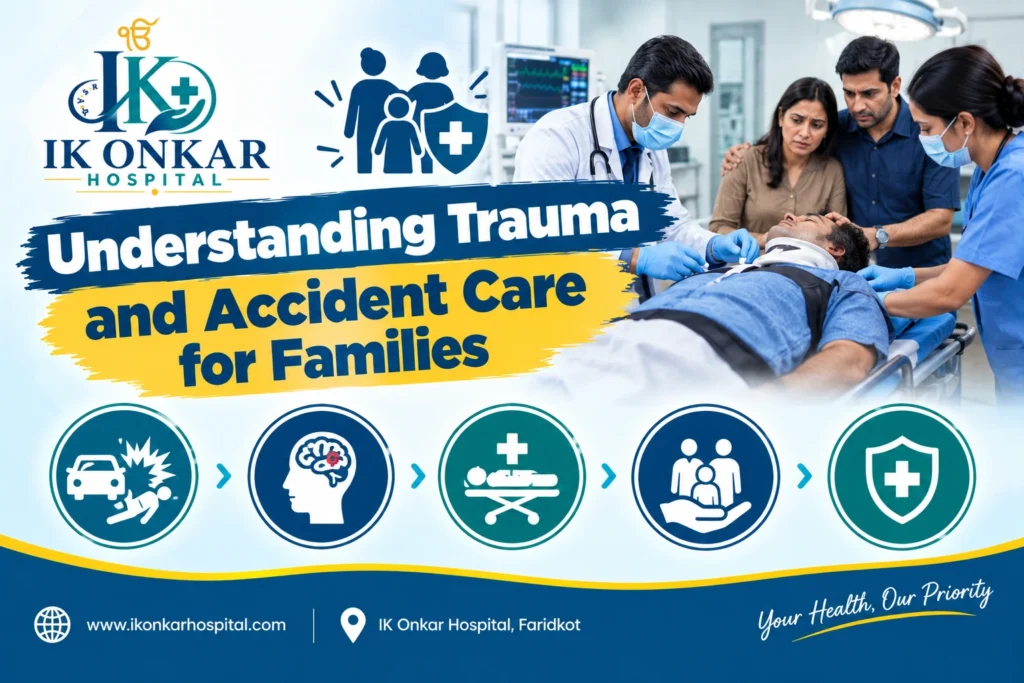
An accident can leave a family with urgent choices. Knowing the basics of trauma and accident care helps you spot danger signs. It also helps you act safely and share useful details with doctors.
Trauma and accident care covers the check-up and treatment of injuries. These injuries come from road crashes, falls, work accidents, and other physical harm. Some injuries show right away. However, others stay hidden at first. Internal bleeding and head injuries are two examples.
This guide explains common injuries and first aid at the scene. In addition, it shows how doctors assess trauma. Finally, it helps you find trauma care Faridkot families can turn to.
What Is Trauma and Accident Care?
Trauma and accident care is the check-up, stabilisation, and treatment of injuries caused by an outside event. First, doctors look for life-threatening problems. Next, they stop further harm. Then they plan the right treatment.
The care needed depends on the injury. For example, a small cut may need only cleaning and a dressing. A serious road accident, however, may need emergency trauma care. It may also need scans, surgery, or a transfer to a specialist hospital.
Many professionals can take part in trauma treatment. These include emergency doctors, nurses, radiology staff, surgeons, and bone specialists. Rehabilitation teams may join as well. The team depends on the patient’s condition and the hospital’s services.
Not every accident needs a hospital stay. Even so, serious symptoms should lead to a doctor’s check-up. The same is true when you doubt how major an injury is. Guesswork is never safe.
What Types of Injuries Can Happen After an Accident?
Accidents can harm many parts of the body. Also, a person may have more than one injury. This can be true even if only one area hurts.
Head and brain injuries
A blow to the head can cause a scalp wound, concussion, skull fracture, or brain injury. Warning signs include:
- Loss of consciousness
- Repeated vomiting
- A headache that gets worse
- Confusion or seizures
- Unusual sleepiness or weakness
A person can have a serious head injury with no visible wound. Therefore, seek emergency trauma care if these signs appear after an accident.
Fractures and joint injuries
A fracture is a broken bone. It can happen in a road accident, a fall, or a direct hit. Severe pain, swelling, a bent limb, or trouble putting weight on a leg may signal a serious injury.
Do not try to straighten a bent limb. Likewise, do not push a bone back into place. Instead, keep the area still and get medical help.
Cuts, bleeding, and soft-tissue injuries
Accidents can cause cuts, bruises, scrapes, and muscle injuries. They can also damage tendons or ligaments. Heavy bleeding needs help at once. In addition, deep wounds need quick care. So do wounds from dirty or sharp objects. The same goes for injuries with numbness or loss of movement.
Remember that a small wound can hide deeper damage under the skin.
Chest, abdominal, and spinal injuries
A strong impact can hurt the ribs, lungs, belly organs, or spine. After an accident, watch for:
- Severe chest pain
- Trouble breathing
- Belly pain or swelling
- Weakness or numbness
- Loss of movement
Do not assume a person is safe because they can talk or walk. In fact, some internal injuries become clear only with time.
What Should You Do Immediately After an Accident?
The right response depends on the scene and the injured person. First, keep yourself safe. Then call for help. After that, avoid actions that could make the injury worse.
Follow these steps:
- Check for danger. Look for moving traffic, fire, fuel leaks, or live wires. Do not put yourself at risk.
- Call for help. In India, dial 112 for a serious injury. Then give the exact location and say what happened.
- Check responsiveness and breathing. If the person is not responding or not breathing normally, follow the call handler’s advice. Start CPR only if you are trained.
- Control heavy bleeding. Press firmly with a clean cloth. However, if an object is stuck in the wound, do not press on it. Press around it instead.
- Avoid moving the person. Take extra care with head, neck, back, or major limb injuries. Move them only if the scene is unsafe.
- Keep watching. Look for changes in breathing, alertness, pain, or bleeding until help arrives.
Do not give food, water, or medicine to a badly hurt or drowsy person. Also, do not remove a stuck object. If the person wears a helmet, leave it on unless it blocks breathing. Above all, follow the advice of emergency staff.
You can learn more from India’s official Emergency Response Support System.
When Does an Accident Injury Need Emergency Trauma Care?
Emergency trauma care is needed when an injury may threaten life. It is also needed when breathing, blood flow, brain function, or safe movement is at risk.
Call for help or go to a hospital at once if a person has:
- Severe trouble breathing
- Heavy bleeding that does not stop with firm pressure
- Loss of consciousness, seizures, or trouble waking up
- Confusion or strange behaviour after a head injury
- Severe belly pain or swelling after an impact
- Suspected spine injury, new weakness, or numbness
- An open fracture or a limb that turns cold, pale, or numb
- Signs of shock, such as collapse, pale and clammy skin, or fast breathing
This list is not complete. Therefore, a person may need urgent care even without these signs.
Children, older adults, pregnant women, and people on blood-thinning medicines need extra caution. If you are unsure, get a doctor’s advice quickly.
How Do Doctors Assess Trauma Injuries?
First, doctors look for threats to life. Next, they ask how the accident happened. They also check symptoms, medical history, and exam findings.
The assessment may include:
- Initial stabilisation: Checking airway, breathing, blood flow, alertness, and major bleeding.
- Physical exam: Looking for wounds, swelling, tenderness, and changes in movement or feeling.
- Nerve check: Testing alertness, reflexes, and strength.
- Imaging: X-rays, ultrasound, or CT scans, when needed.
- Blood tests: Used when the injury or condition calls for them.
Not every patient needs every test. Instead, the doctor chooses tests based on the findings. Moreover, if the hospital cannot handle the injury, the patient may move to a hospital with the right specialists.
What Does Trauma Treatment Involve?
Trauma treatment depends on the injury, its severity, and the patient’s overall health. The goal is simple. Doctors stabilise the patient and treat each injury. They also reduce the risk of complications and plan follow-up care.
Trauma treatment may include:
- Cleaning and dressing wounds
- Stopping bleeding and checking for deeper damage
- Keeping a broken bone still and arranging a bone specialist’s review
- Treating head, chest, or belly injuries based on the findings
- Giving fluids, pain relief, and close monitoring
- Arranging surgery or specialist care when needed
- Referring the patient for rehabilitation
A serious injury may need more advanced care than a local hospital can give. Therefore, ask the team whether the right specialists, equipment, scans, and emergency support are available. A transfer may be advised if another hospital can offer better care.
Above all, do not delay emergency treatment while trying to guess the diagnosis at home.
What Should Families Know About Recovery?
Recovery depends on the injury, the person’s age, their health, and the treatment. For instance, a minor muscle injury may heal fast. In contrast, a fracture, brain injury, or major trauma may need long treatment and rehabilitation.
Before leaving the hospital, families should ask:
- Which injuries were found, and which concerns remain?
- How should wounds, dressings, or casts be cared for?
- Which activities should be avoided, and for how long?
- When is the next follow-up visit?
- Which symptoms mean the patient must return at once?
- Is physiotherapy or other rehabilitation needed?
Follow the doctor’s advice and attend every follow-up. Also, seek urgent help if pain worsens or bleeding restarts. The same applies if breathing becomes hard or new weakness or confusion appears.
How Can Families Prevent Further Injury?
Accidents cannot always be avoided. Still, simple steps can lower the risk.
- Wear a well-fitted helmet on a two-wheeler, and use seat belts in cars.
- Follow traffic rules. Avoid driving when tired, distracted, or unwell.
- Use protective gear at work and during risky activities.
- Keep stairs and walkways clear of trip hazards.
- Store sharp tools and chemicals safely.
- Keep emergency numbers handy, and learn basic first aid from a trained provider.
In addition, families should know where the nearest emergency facility is. As a result, it becomes easier to stay calm when an accident happens.
Trauma and Accident Care in Faridkot
When looking for trauma care Faridkot residents can trust, first consider how serious the injury is. Next, check whether the hospital can give the treatment needed. The nearest hospital may be right for the first check-up. However, some injuries need specialist care or a transfer.
Ik Onkar Hospital is located at the Former Dashmesh Hospital Building, Talwandi Road, Faridkot, Punjab.
For non-emergency questions, contact the hospital. Ask about its current emergency arrangements and the injuries it can treat. Also ask which scans or specialists are available.
Useful questions include:
- Is emergency assessment available when needed?
- Which accident injuries can the hospital treat?
- Are scans and specialist visits available?
- What happens if surgery or an unavailable service is needed?
- How are referrals and transfers arranged?
Services can change. Therefore, confirm details directly, and do not assume a service is available.
If someone has a life-threatening injury, call 112 or go for emergency help at once. Do not delay urgent care to make a routine enquiry.
Conclusion
Knowing trauma and accident care helps families act more safely after an injury. In short, scene safety, quick emergency help, correct first aid, and timely medical review are the key steps. Moreover, serious injuries are not always obvious. For this reason, never ignore warning signs.
For families in Faridkot, the right trauma treatment depends on the patient’s condition and the hospital’s services. Contact Ik Onkar Hospital for non-emergency details about its trauma care Faridkot services. Finally, use emergency services at once when an injury may be life-threatening.
This article gives general health information. It is not a diagnosis or a treatment plan. In an emergency, call emergency services and follow the advice of qualified medical professionals.